
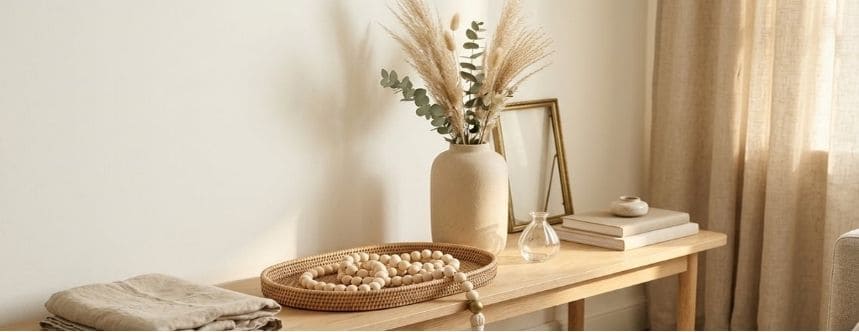
A wooden bead strand, a glass ornament, and a metal charm can each look lovely on their own, yet feel busy when you place them together.
Coordinating handmade home decor means choosing materials that share a connection while giving each texture a clear role, and I’ve found that’s what makes a display feel calm instead of cluttered.
Start with the room, choose a focused color palette, and check proportions before you buy.
Your handmade accents can then sit comfortably alongside ready-made vases, trays, and decorative objects.
Start with the Room, Not the Materials
Before you choose beads, cords, or embellishments, decide where the decoration will live.
A narrow entryway shelf needs different proportions than a large dining table.
Look at your nearby furniture, textiles, and metal finishes for guidance, since they already tell the story of how your room feels.
Pale wooden furniture and linen curtains suggest natural wood beads, cotton cord, and a small brass-colored accent.
A room with glass accessories may suit transparent beads and smoother finishes.
I’d choose one existing object you love as your reference rather than trying to repeat everything in the room.
Build a Simple Color Palette
Choose a main color, a supporting color, and a small accent.
For example, cream beads and natural cotton cord could form the base, with a few antique-gold details adding contrast.
If your room already has strong patterns, I’d repeat one existing color and keep the rest of your materials quieter.
Check undertones as well as color names.
Two materials described as “white” may look different together, one creamy and warm, the other bright and cool.
I always compare samples in daylight and lamplight before committing, since evening is often when you’ll enjoy the piece most.
Mix Textures with a Clear Focal Point
Wood brings visible grain, glass adds shine or transparency, metal gives definition, and fabric softens the mix.
Choose one texture to lead.
Wooden beads and cotton cord might take the lead in a natural-looking piece, while clear glass could be the star of a window decoration that catches the morning light.
I’d avoid giving every material equal emphasis.
Sparkling spacers, elaborate charms, glossy beads, and patterned ribbon can compete in a small decoration.
If your combination feels crowded, remove one element before adding anything else, because a little breathing room is what helps a space feel restful.
Repeat a nearby finish to connect the piece to its setting.
A brushed-metal detail can echo a picture frame, while matte beads can complement an unglazed ceramic vase.
Balance Scale, Weight, and Fit
A large pendant can overwhelm small beads, while tiny embellishments may disappear in a room display.
I like to lay materials out at their intended size and view them from where you’ll usually see them, like your sofa or the doorway.
For hanging pieces, check that the cord, connectors, and hanging point can support the finished decoration.
Before you buy, I’d check these practical details:
- Bead holes and cord diameter: Leave enough room for threading and doubled sections.
- Connector openings: Make sure they fit the components you’re joining.
- Surface finishes: Avoid rough edges that could damage cord or catch fabric.
- Finished dimensions: Include tassels, knots, and hanging loops.
Three Material Combinations to Try
Use these combinations as starting points, then adapt them to your room and the mood you want it to have.
| Look | Materials to combine | Ready-made pieces to pair with them | What keeps it coordinated |
|---|---|---|---|
| Natural and warm | Wooden beads, cotton cord, restrained matte-metal accents | A ceramic vase or wooden tray | Similar warm undertones with varied textures |
| Light and airy | Clear glass beads, pale cord, a few silver-colored details | A glass vase or simple pale ornament | Transparency and a limited color palette |
| Soft and vintage-inspired | Cream beads, muted ribbon, antique-bronze-colored charms | A small decorative figurine or aged picture frame | Repeated metal finishes and gentle colors |
Combine Handmade Details with Ready-Made Decor
Ready-made pieces give an arrangement structure, while handmade accents add a personal detail that tells guests a little something about you.
A shallow tray can hold a wooden bead strand beside a small vase.
The tray defines the space, the vase adds height, and the beads bring in a softer line.
Keep one focal point.
Pair a detailed figurine with a simpler handmade accent, or place an intricate handmade piece beside quieter objects.
Leave space between items so their shapes stay visible.
Plan Your Materials Before You Buy
Before ordering, I’d compare photos of your room, existing objects, and the DIY materials you’re considering on a simple reference board.
This can reveal mismatched colors or proportions early, before they cost you time or money.
A supplier that carries both craft components and finished decorative pieces can help you explore those combinations.
PandaHall offers DIY materials alongside ready-made home decor and decorative objects, allowing you to consider both parts of an arrangement during planning.
When you’re browsing jewelry wholesale categories for beads, charms, or connectors, compare measurements rather than enlarged photos.
Components meant for small accessories may look much smaller in a room display.
Check package quantities, and test a small selection when you can before buying more.
I always view chosen materials in the room’s light before assembling or arranging them.
A shared color, a repeated finish, and a little empty space can bring your handmade and ready-made decor together into a corner that feels like yours.
Frequently Asked Questions
Can I Mix Wood, Glass, and Metal in One Decoration?
Yes. Give one material the main role and use the others as accents.
Repeating a color or finish helps connect the different textures.
Does Handmade Decor Need to Match the Room Exactly?
No.
Repeating one or two existing elements, like a wood tone, accent color, or metal finish, is usually enough to create a connection while leaving room for contrast.
How Can I Make Handmade and Ready-Made Pieces Look Cohesive?
Choose a shared detail, vary the height and shape of your objects, and keep one clear focal point.
Start with a small arrangement and adjust it in place.
The most useful test I know is to view the materials where the finished decoration will live.
Check them in the room’s light, remove anything that competes for attention, and let a few well-chosen details bring your arrangement together into something that feels warm and welcoming every time you walk by.